2025April

generateUUID() util in vercel/ai-chatbot source code.

In this article, we will review a function, generateUUID, found in vercel/ai-chatbot source code but first, let’s find out where this function is called from.

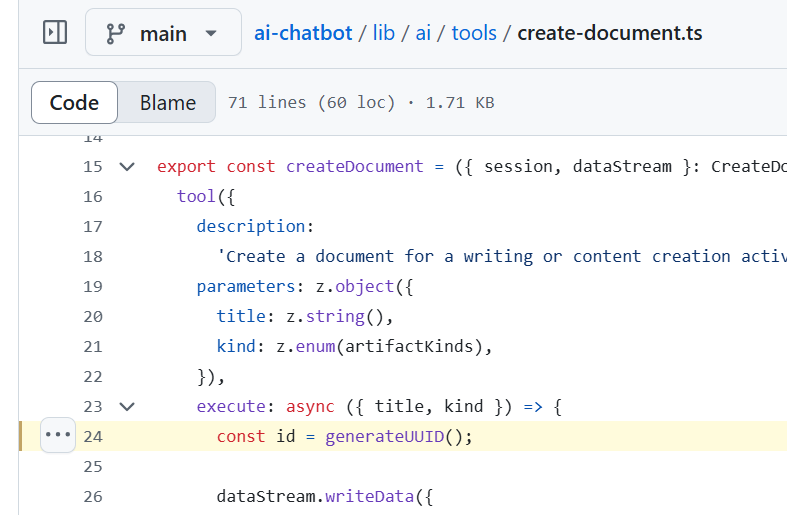
In the file, create-document.ts, you will find the below import at line #1

import { generateUUID } from '@/lib/utils';

and then at line #24, you will this function being called inside the execute function

 execute: async ({ title, kind }) => {
      const id = generateUUID();

Okay, now that we saw how this function is called, let’s learn its definition.

At line #48, in lib/util.ts, You will find the below code:

export function generateUUID(): string {
  return 'xxxxxxxx-xxxx-4xxx-yxxx-xxxxxxxxxxxx'.replace(/[xy]/g, (c) => {
    const r = (Math.random() * 16) | 0;
    const v = c === 'x' ? r : (r & 0x3) | 0x8;
    return v.toString(16);
  });
}

This function is obviously used to generate random id but the algorithm used here is something I haven’t seen before.

'xxxxxxxx-xxxx-4xxx-yxxx-xxxxxxxxxxxx'.replace(/[xy]/g, (c)

It uses .replace(/[xy]/g, ...) to find every x or y in the string and replace it with a computed value. — Source: ChatGPT

const r = (Math.random() * 16) | 0;

This is a quick and clever way to generate a random integer between 0 and 15 (inclusive). — Source: ChatGPT

const v = c === 'x' ? r : (r & 0x3) | 0x8;

If the character is 'x':

v = r;

Just use the random value r (between 0–15).

No constraints — we just need a hex digit

If the character is 'y':

v = (r & 0x3) | 0x8;

This is bit-level wizardry to force the y digit to follow the UUID variant rules, which say:

The first two bits of the y character should be 10 in binary.

So, here’s how the logic achieves that:

Step-by-step:

r & 0x3: keeps only the last 2 bits of r
→ this gives values between 0 and 3 (00, 01, 10, 11)

| 0x8: sets the first two bits to 10 (i.e., 1000 in binary → 8 in hex)

That guarantees v will be one of:

8 (1000), 9 (1001), a (1010), or b (1011)

— Source: ChatGPT

I highlighted the answers from ChatGPT here in this article, but from what I understood, that “y” in the string exists for a reason and that reason is that UUID follows a guideline that expects “y” to follow a certain pattern.

About me:

Hey, my name is Ramu Narasinga. I study large open-source projects and create content about their codebase architecture and best practices, sharing it through articles, videos.

I am open to work on interesting projects. Send me an email at ramu.narasinga@gmail.com

My Github — https://github.com/ramu-narasinga

My website — https://ramunarasinga.com

My Youtube channel — https://www.youtube.com/@ramu-narasinga

Learning platform — https://thinkthroo.com

Codebase Architecture — https://app.thinkthroo.com/architecture

Best practices — https://app.thinkthroo.com/best-practices

Production-grade projects — https://app.thinkthroo.com/production-grade-projects

References:

  1. https://github.com/vercel/ai-chatbot/blob/main/lib/ai/tools/create-document.ts#L1

  2. https://github.com/vercel/ai-chatbot/blob/main/lib/ai/tools/create-document.ts#L24

  3. https://github.com/vercel/ai-chatbot/blob/main/lib/utils.ts#L48

  4. https://github.com/uuidjs/uuid/tree/main/src

We use cookies
We use cookies to ensure you get the best experience on our website. For more information on how we use cookies, please see our cookie policy.

By clicking "Accept", you agree to our use of cookies.

Learn more