Zustand allows you to define stores with custom equality functions using createWithEqualityFn. In this test, the initial state is defined as:
const initialState: State = { value: 'foo' }
The createWithEqualityFn function is used to create a store where the equality function is defined to compare states based on whether the value property is equal. In this case, the equality checker is intentionally set to throw an error when value is of a type other than string:
You can intentionally throw errors in your test cases to ensure your code handles errors as expected.
const equalityFn = (a: State, b: State) =>
  a.value.trim() === b.value.trim() // Throws error if 'value' is not a string
The test case expects this equality function to fail when value becomes a number, causing the error handler to come into play.
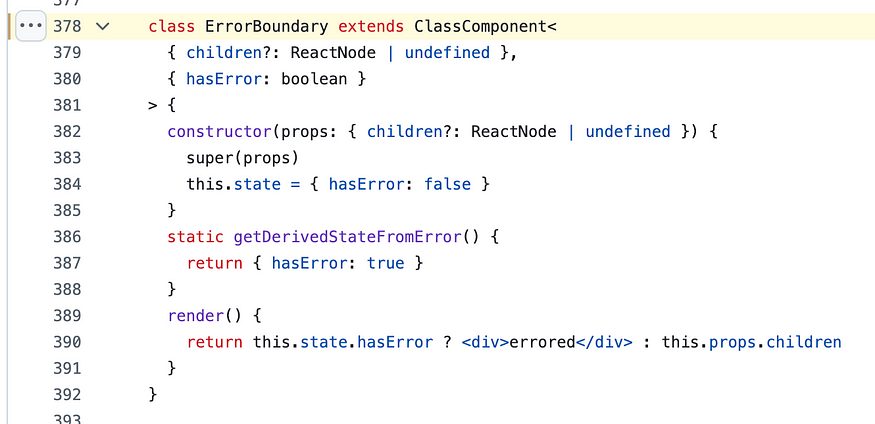
React’s ErrorBoundary component is a common pattern used to catch JavaScript errors in a component tree, and Zustand has taken this approach to test how errors within their state management are handled. This particular test case defines a custom ErrorBoundary component directly inside the test. I mean, how often do you come across a test case that has the custom ErrorBoundary with in a “test case”?
The component uses the lifecycle method getDerivedStateFromError() to catch errors and update its state (hasError) to true.
If an error is detected, the component renders <div>errored</div>. Otherwise, it renders its children.
In typical production use, ErrorBoundary components are created as reusable elements to catch and display errors across the application. However, embedding the ErrorBoundary directly inside a test case like this provides fine-grained control over error testing, allowing you to assert that the component reacts correctly when errors occur in specific parts of the application.
In this test case, Vitest is used as the testing framework. Here’s how it works with Zustand:
Rendering the Component: The Component that uses the useBoundStore hook is rendered inside the ErrorBoundary within a React StrictMode block. This ensures that errors inside the equality checker can be caught.
What makes this test case particularly interesting is the use of an inline ErrorBoundary component within a unit test. Typically, error boundaries are part of the main React app, wrapping components in the main render tree. However, Zustand's approach to create an error boundary in the test suite itself offers a more flexible and isolated way to test how errors are handled under specific conditions.
By directly controlling the boundary within the test, Zustand ensures:
Granularity: The test can focus on how errors in a particular part of the application (like the equality checker) are handled, without needing to rely on global error boundaries.
Test Isolation: The ErrorBoundary exists only within the scope of this test, reducing potential side effects or dependencies on the app’s broader error-handling logic.
Hey, my name is Ramu Narasinga. I study large open-source projects and create content about their codebase architecture and best practices, sharing it through articles, videos.